
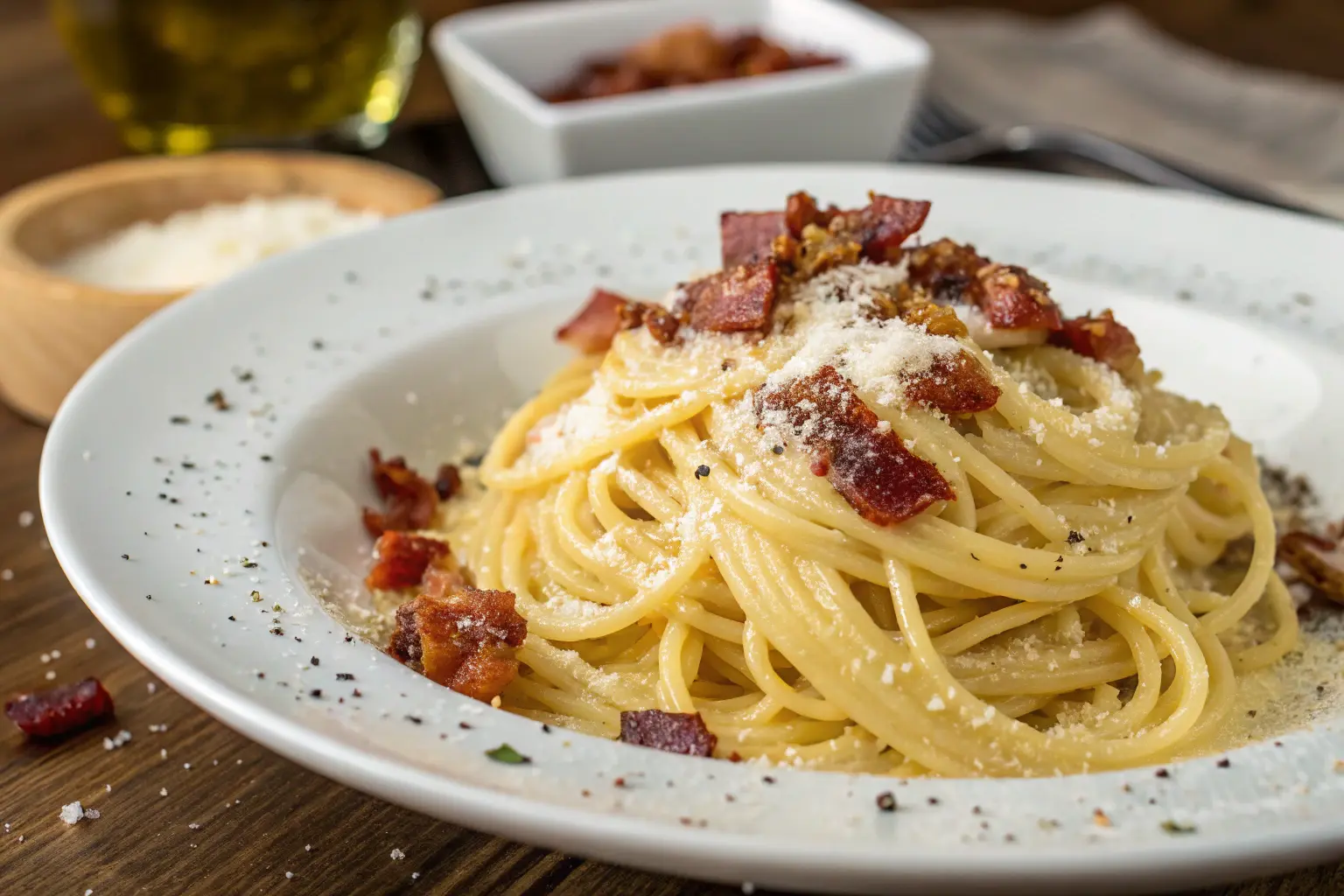
A good carbonara recipe is one of the most satisfying things you can cook, and one of the most misunderstood. Most versions you encounter outside of Rome are missing the point: cream is added where none belongs, the wrong cut of pork is used, and the sauce ends up either scrambled or stodgy. This guide corrects all of that. You will find the authentic recipe, the science behind why it works, the technique that prevents every common mistake and enough context to understand why this dish, with its five ingredients, is one of the great achievements of Italian cooking.
If you are curious about the traditional ingredients behind this dish, you can explore a deeper breakdown in this guide on what carbonara is made of.
Table of Contents
What Is Carbonara?
Definition of Carbonara
Carbonara is a Roman pasta dish made from pasta, cured pork fat, eggs, aged cheese and black pepper. The sauce is not cooked in a pan. It forms on the pasta itself through the emulsification of egg yolks and cheese with the heat of the pasta and the starch of the cooking water. The result is a glossy, creamy, deeply savory coating that clings to every strand of pasta without a single drop of cream.
Why Carbonara Is Different from Other Pasta
Most pasta dishes involve a sauce that is prepared separately and then combined with the cooked pasta at the end. Carbonara is different: there is no separate sauce. The sauce is created in the moment of combining, using the residual heat of the pasta, the fat rendered from the guanciale, and the emulsifying power of the eggs and cheese. This is why technique matters more than any individual ingredient in carbonara. The dish rewards precision and punishes inattention.
The Origin and Meaning of Carbonara
Meaning of the Word “Carbonara”
The word “carbonara” derives from the Italian word “carbone,” meaning “charcoal” or “coal.” The generous coating of coarsely ground black pepper over the finished dish visually resembles flecks of charcoal, which is the most widely accepted explanation for the name. Some also point to the dish’s historic association with outdoor workers who built fires and cooked over coal.
Historical Theories
The exact origin of carbonara is debated among food historians, and none of the competing theories is definitively proven. The most romantic version traces the dish to the Carbonari, the charcoal burners of the Apennine Mountains who prepared simple, shelf-stable food over open fires using cured pork, dried pasta, and eggs. The abundance of black pepper in the recipe reinforces this connection, pepper being one of the oldest and most portable spices available to workers far from markets.
A second theory, with more documentary support, places carbonara in Rome in the immediate post-World War II period, when American soldiers stationed in Italy were known to cook combinations of bacon and powdered eggs over pasta. This theory suggests that Italian cooks adapted the concept, replacing American ingredients with guanciale and fresh eggs, and the modern dish emerged from that fusion.
What is historically certain is that carbonara does not appear in Italian cookbooks before the mid-twentieth century, making it one of the newer classics of the Roman culinary tradition despite feeling ancient in its simplicity.
Ingredients for Authentic Carbonara
Essential Ingredients List
Spaghetti (or rigatoni, 320g for 4 servings). Spaghetti is the most traditional choice and the one with the best surface for the sauce to cling to. Rigatoni is a worthy alternative for those who prefer a tubular shape with more interior sauce capture.
Guanciale (150g). Guanciale is cured pork cheek, and it is the only truly authentic choice for carbonara. It has a higher fat content than pancetta or bacon, renders more slowly, and produces a sweeter, more complex flavor. The fat it releases is the fat that coats the pasta before the egg mixture is added, and it is essential to the dish’s character.
Egg yolks (4 yolks plus 1 whole egg). The yolks provide richness and the proteins that form the creamy emulsion. Using mostly yolks rather than whole eggs gives the sauce more body and a deeper golden color. The one whole egg adds a small amount of white that helps loosen the mixture slightly.
Pecorino Romano (80g, finely grated). Pecorino Romano is the traditional cheese of Roman cooking. It is saltier, sharper, and more assertive than Parmesan. Using it alone gives the authentic flavor profile of the dish. Some recipes use a blend of Pecorino and Parmigiano-Reggiano (half and half) for a slightly more rounded, less aggressive result.
Black pepper (abundant, freshly ground). This is not a garnish. Freshly ground black pepper is ground directly into the sauce, in generous quantity, and contributes a heat and complexity that is essential to the dish. Pre-ground pepper is a poor substitute.
Pasta cooking water (as needed). Starchy pasta water is the adjusting agent that controls the consistency of the sauce. It should be reserved before draining and kept hot throughout the finishing process.
Ingredient Substitutions (If Needed)
Guanciale to pancetta. Pancetta is cured pork belly with a higher ratio of meat to fat. It produces a slightly leaner result with a different flavor profile. If guanciale is unavailable, pancetta is the closest acceptable substitute. Bacon (smoked) is a further step away: it can be used, but the smoky flavor changes the character of the dish significantly.
Pecorino to Parmesan blend. Using 50g of Pecorino Romano and 30g of Parmigiano-Reggiano produces a sauce that is slightly milder and more approachable than pure Pecorino, while still maintaining substantial depth. Do not use pre-grated cheese from a container: the powdered texture prevents proper emulsification.
Ingredients Breakdown Table
| Ingredient | Role in the Dish | Notes |
|---|---|---|
| Pasta | Structural base, starch source | Must be al dente, never overcooked |
| Guanciale | Primary fat and flavor source | The most critical ingredient for authentic flavor |
| Eggs (yolks + 1 whole) | Forms the creamy sauce via emulsification | Temperature control is essential to avoid scrambling |
| Pecorino Romano | Salt, umami and emulsification support | Must be finely grated, not pre-powdered |
| Black pepper | Heat, depth and the dish’s signature character | Freshly ground only, used generously |
| Pasta cooking water | Adjusts sauce consistency, aids emulsification | Reserve before draining, keep hot throughout |
Authentic Carbonara Recipe
A traditional Roman carbonara made with eggs, Pecorino Romano, guanciale, and black pepper, creating a creamy sauce without any cream.
- Prep Time: 10 minutes
- Cook Time: 20 minutes
- Total Time: 30 minutes
- Yield: 4 servings 1x
- Category: Main Course
- Method: Stovetop
- Cuisine: Italian
Ingredients
- 320g spaghetti
- 150g guanciale
- 4 egg yolks
- 1 whole egg
- 80g Pecorino Romano cheese, finely grated
- Freshly ground black pepper
- Salt for pasta water
- Pasta cooking water (as needed)
Instructions
- Bring a large pot of salted water to a boil.
- Cook spaghetti until al dente.
- Reserve 2 cups of pasta water before draining.
- Cut guanciale into small pieces.
- Cook guanciale in a pan over medium-low heat until crispy.
- In a bowl, whisk egg yolks, whole egg, Pecorino Romano, and black pepper.
- Add a small amount of hot pasta water to the egg mixture and whisk.
- Add drained pasta to the guanciale and toss off heat.
- Pour egg mixture over pasta and toss quickly to create a creamy sauce.
- Add pasta water gradually until sauce is smooth and glossy.
- Serve immediately with extra cheese and pepper.
Notes
Do not add cream. Always remove from heat before adding eggs to prevent scrambling. Use freshly grated cheese for best results.
Nutrition
- Serving Size: 1 portion
- Calories: 600
- Sugar: 2g
- Sodium: 650mg
- Fat: 28g
- Saturated Fat: 10g
- Unsaturated Fat: 16g
- Trans Fat: 0g
- Carbohydrates: 55g
- Fiber: 3g
- Protein: 25g
- Cholesterol: 220mg
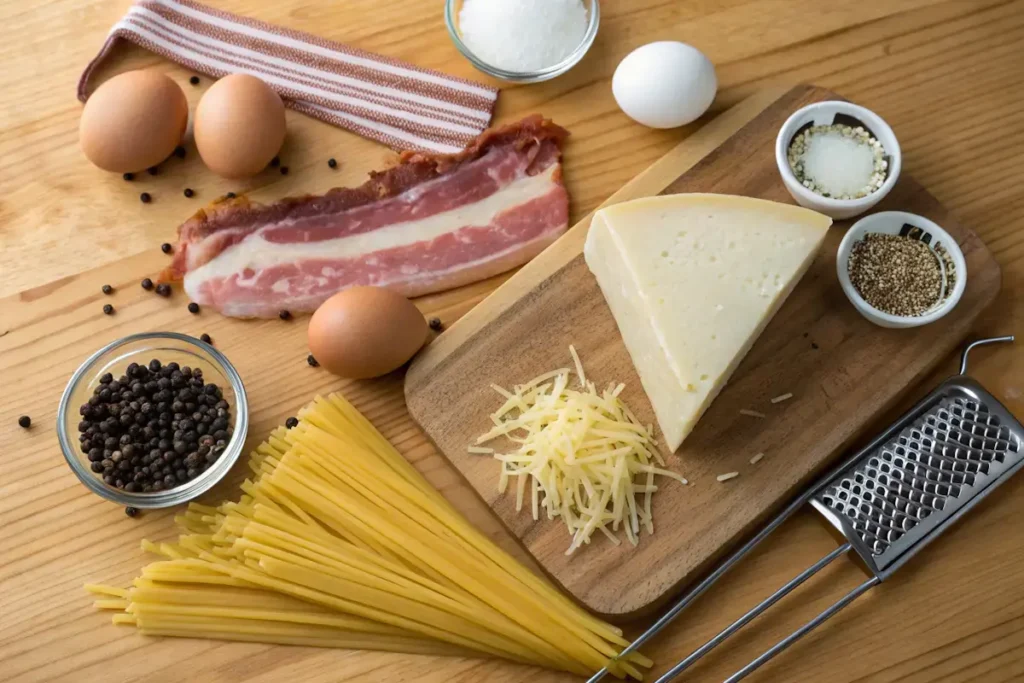
For a deeper understanding of the specific cut of pork used and why it matters, see this detailed guide on what meat is used in carbonara.
Why Carbonara Has No Cream
How the Creamy Texture Actually Works
The creamy texture of authentic carbonara is the result of emulsification, the same process that makes mayonnaise stable and hollandaise glossy. When the egg yolks (which contain lecithin, a natural emulsifier) are combined with the finely grated cheese, the starchy pasta water and the rendered fat from the guanciale, they form a stable emulsion that coats every strand of pasta in a smooth, clingy, silky sauce.
The key to this emulsion forming successfully rather than curdling is temperature control. The proteins in egg yolks begin to set at approximately 63 degrees C and scramble irreversibly above approximately 80 degrees C. The entire technique of finishing carbonara off the heat is designed to keep the pasta within that narrow window where the eggs cook gently into a sauce rather than scrambling into curds.
To better understand how the sauce works at a technical level, this guide explains the science behind carbonara sauce in detail.
What Happens If You Add Cream
Adding cream to carbonara is not simply an inauthentic choice. It fundamentally changes the dish in ways that make it worse by the standards of what carbonara is supposed to be. Cream dilutes the intense savory richness of the egg-and-cheese emulsion, replaces the clean protein-fat interaction of the eggs with a heavier, fattier texture, and obscures the flavor of the guanciale and Pecorino. The result tastes like a cream sauce with pasta, which is a fine thing to make, but it is not carbonara.
Step-by-Step Carbonara Recipe
Prep time: 10 minutes | Cook time: 20 minutes | Servings: 4 | Calories: approximately 600 per serving
Step 1: Boil the Pasta
Bring a large pot of well-salted water to a rolling boil. Use approximately 10 grams of salt per liter of water. Add the spaghetti and cook until it is al dente, 1 to 2 minutes less than the package instructions. Before draining, reserve at least 2 full cups of the starchy cooking water in a heatproof container. The pasta water is the single most important adjusting tool in the recipe, and you will need more of it than you expect. Drain the pasta but do not rinse it.
Step 2: Cook the guanciale.
While the pasta cooks, cut the guanciale into small cubes or thick strips. Place them in a cold pan over medium-low heat. Starting from cold allows the fat to render gradually and evenly rather than seizing on contact with a hot surface. Cook, stirring occasionally, for 8 to 10 minutes until the fat is fully rendered and the guanciale pieces are crisp at the edges with a translucent interior. Remove the pan from the heat. Do not discard the rendered fat: it is essential to the sauce.
Step 3: Prepare the Egg Mixture
In a large bowl (large enough to hold all the pasta comfortably), combine the 4 egg yolks and 1 whole egg with the finely grated Pecorino Romano and a generous amount of freshly ground black pepper. Whisk together until the mixture is homogeneous and slightly thick. At this stage, add 2 tablespoons of the reserved hot pasta water and whisk again to slightly temper the eggs, bringing their temperature up gently before they contact the pasta.
Step 4: Combine Pasta and Guanciale
Add the drained pasta directly to the pan with the guanciale and rendered fat, off the heat. Toss vigorously to coat every strand of pasta in the fat. The fat is what allows the egg mixture to slide and emulsify rather than stick and scramble.
Step 5: Create the Sauce
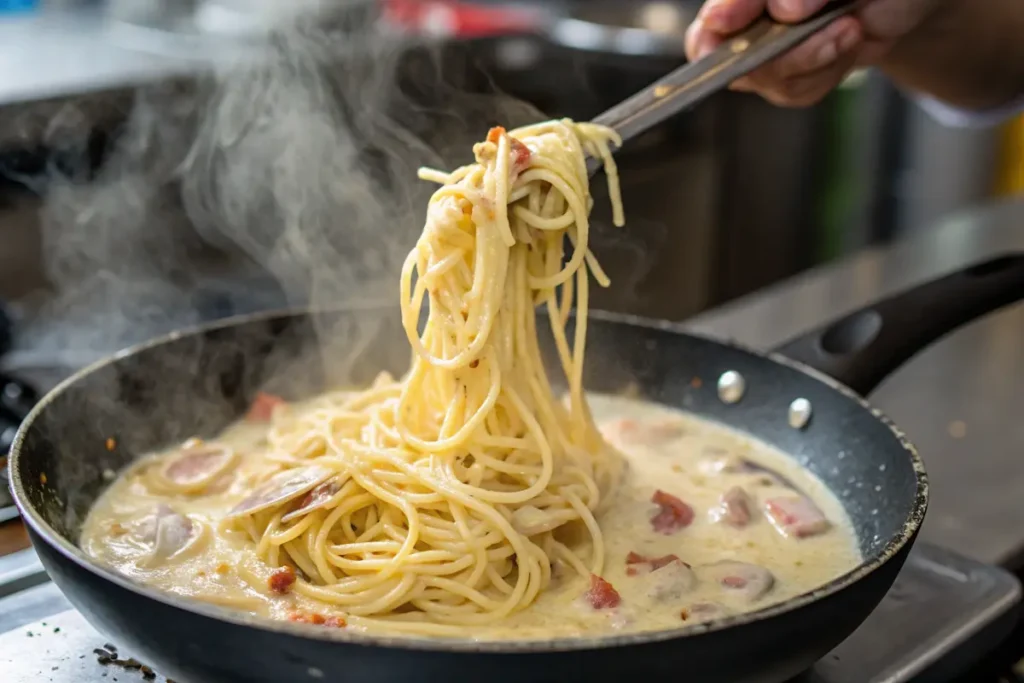
Remove the pasta-guanciale pan from any residual heat and let it rest for 30 seconds. This cooling step is critical: if the pan is too hot when the eggs are added, they will scramble. Pour the egg and cheese mixture over the pasta. Using tongs or two forks, toss rapidly and continuously, lifting the pasta from the bottom of the pan and turning it constantly. The sauce will begin to form within 30 to 60 seconds of continuous movement.
Step 6: Adjust with Pasta Water
The sauce should be glossy and flowing, coating the pasta without pooling at the bottom of the pan. Add the reserved hot pasta water one splash at a time, tossing between each addition, until you reach this consistency. The starch in the water binds to the fat and egg protein, creating the emulsion that gives carbonara its characteristic texture. Do not add too much water at once: it is much easier to add more than to recover from a watery sauce.
Serve immediately, finishing each portion with an additional grind of black pepper and a small amount of extra Pecorino over the top.
The Science Behind Carbonara
Egg Protein Behavior
Egg yolk proteins begin to denature (unfold and set) at approximately 63 degrees C and are fully set and beginning to tighten at 70 to 72 degrees C. Above 80 degrees C, the proteins contract sharply and water is squeezed out, producing the grainy, dry texture of scrambled eggs. Carbonara’s entire technique is designed to keep the egg proteins within the 63 to 72 degree window, where they set smoothly and continuously rather than sharply and irreversibly.
Role of Starch
The starch in pasta cooking water is the emulsification support system of carbonara. Starch molecules are large and hydrophilic (water-loving) at their core but have surface regions that interact with fat. When starch is present in the sauce, it acts as a bridge between the fat-soluble and water-soluble components of the emulsion, keeping the sauce stable and preventing it from separating into greasy puddles and watery liquid.
Importance of Temperature Control
Temperature is not just one factor in carbonara. It is the factor. The pasta must be hot enough to cook the eggs but not so hot that it scrambles them. The pan must be warm enough to allow the emulsion to form but not hot enough to cause it to break. Every step of the recipe is designed around managing this narrow thermal window. This is why professional cooks consider carbonara technically demanding despite its short ingredient list.
Common Mistakes to Avoid
Scrambled eggs. The most common failure in homemade carbonara. Caused by adding the egg mixture to pasta that is still over direct heat or to a pan that is too hot. Always remove from heat and let rest 30 seconds before adding the eggs. Continuous movement is also essential: stationary eggs in a hot pan scramble faster than eggs that are being tossed constantly.
Dry pasta. Carbonara that clumps and sticks rather than flowing comes from insufficient pasta water and insufficient fat. Reserve more water than you think you need, work quickly after draining the pasta, and do not skip the step of tossing the pasta in the guanciale fat before adding the eggs.
Weak flavor. Often caused by under-seasoning the pasta water, using too little Pecorino, using pre-grated powdered cheese instead of freshly grated, or using too little black pepper. Carbonara should taste bold and assertive. If it tastes mild, something has been undersized.
Using cream. As discussed above, cream is not authentic and does not improve the dish. It replaces the technical achievement of the egg emulsion with a simple cream sauce that has a fundamentally different texture and flavor.
Many people confuse authentic carbonara with creamy versions. If you are wondering about those differences, this article breaks down creamy carbonara ingredients and variations in detail.
Expert Tips for Perfect Carbonara
Use premium ingredients. With five ingredients, every one of them matters. Guanciale from a good Italian deli or specialty supplier is worth the extra cost. Freshly grated Pecorino Romano from a block is enormously different from pre-grated. Good eggs with deep golden yolks produce a more beautiful sauce than pale supermarket eggs.
Work quickly after draining. The window between draining the pasta and finishing the sauce is short. Have everything prepared and within reach before the pasta goes into the water: guanciale cooked and resting in its pan, egg mixture whisked and ready in the large bowl, pasta water reserved and hot.
Control heat at every stage. Guanciale should never cook over high heat. The pasta should be combined with the egg mixture off direct heat. The water should be added gradually, not all at once.
Keep moving. Tossing the pasta continuously through the sauce-forming stage is what prevents scrambling and creates the emulsion. Do not pause; do not let it sit; do not stop until the sauce is glossy and coating.
Carbonara Variations
Pancetta Version
The closest authentic substitute when guanciale is unavailable. The dish will be slightly leaner and the flavor slightly different (more cured and less sweet) but still very good. The technique is identical.
Parmesan Blend Version
Using 50g Pecorino Romano and 30g Parmigiano-Reggiano produces a milder, more approachable sauce that is particularly useful when serving carbonara to people unfamiliar with the aggressive sharpness of pure Pecorino. This is also a common choice in regions of Italy outside Rome.
Whole Egg Version
Some older Roman recipes use whole eggs rather than a mostly-yolk mixture. The result is a slightly looser, more liquid sauce with a less intense golden color. The technique is the same, but the window of temperature error is slightly narrower because egg whites set at a lower temperature than yolks.
Modern Cream Versions
Versions that add cream, while common in restaurants outside Italy, are a different dish by any technical or historical definition. They are not carbonara in the traditional sense, though they can be enjoyable pasta dishes in their own right. If you encounter a recipe that includes cream and calls itself carbonara, you are reading a modern adaptation, not the Roman original.
If you enjoy rich pasta dishes, you might also like this creamy seafood pasta variation, which uses cream intentionally and with excellent results in a different flavor profile entirely.
What Does Carbonara Taste Like?
Authentic carbonara has a texture that is silky, flowing, and rich without being heavy. The sauce coats the pasta completely and clings to each strand without pooling. It is not thick or gluey, and it is not thin or watery. It is exactly as glossy and smooth as a well-made hollandaise.
The flavor is intensely savory, built around three sources of umami: the cured pork fat of the guanciale, the aged sharpness of the Pecorino, and the depth of the egg yolks. The black pepper cuts through the richness with a genuine heat that is present in every bite without being aggressive. The balance between fat, salt, pepper, and the mild starchiness of the pasta is what makes carbonara so satisfying and so difficult to stop eating.
How to Serve Carbonara
Best Serving Practices
Carbonara must be served immediately after finishing. Unlike most pasta dishes, it does not hold well: the sauce continues to cook from the residual heat of the pasta and will scramble if left to sit for more than a few minutes. Warm the serving bowls or plates with hot water before plating to slow the cooling process. Serve in generous portions in deep bowls that retain heat.
Finish each bowl with an additional grind of coarse black pepper and a light dusting of extra Pecorino over the top. Do not add olive oil, parsley, or other garnishes to an authentic carbonara.
Pairings
A dry, medium-bodied white wine (Frascati or Trebbiano from the Lazio region, the homeland of carbonara) complements the dish well. A light red (Frappato or a young Sangiovese) also works if you prefer red. Avoid full-bodied reds: their tannins clash with the egg richness of the sauce.
A simple green salad dressed with lemon and olive oil is the ideal accompaniment: the acidity cuts through the richness of the pasta and refreshes the palate between bites.
Nutritional Overview
| Nutrient | Approximate Value per Serving |
|---|---|
| Calories | approximately 580 to 640 kcal |
| Protein | 28 to 34g |
| Fat | 26 to 32g |
| Carbohydrates | 65 to 75g |
| Sodium | 800 to 1000mg (from guanciale and Pecorino) |
| Fiber | 2 to 3g |
Frequently Asked Questions About Carbonara
What Are the Ingredients for Carbonara?
The five essential ingredients for an authentic carbonara recipe are pasta (traditionally spaghetti), guanciale (cured pork cheek), eggs (mostly yolks, with one whole egg), Pecorino Romano cheese and freshly ground black pepper. Pasta cooking water is the sixth essential element that adjusts the sauce consistency. No cream, no garlic, no onion and no olive oil belong in a traditional Roman carbonara.
What Goes Into a Traditional Carbonara?
Traditional Roman carbonara contains exactly five ingredients plus pasta water: spaghetti, guanciale, eggs, Pecorino Romano and black pepper. The technique is as important as the ingredient list. The sauce forms through the emulsification of eggs and cheese with the heat of the pasta and the starch of the cooking water, off direct heat. Any version that adds cream, garlic, onion or any additional flavoring is a modern adaptation, not the traditional Roman dish.
What Does Carbonara Mean?
Carbonara derives from the Italian word carbone, meaning charcoal or coal. The name most likely refers to the generous coating of freshly ground black pepper that covers the finished dish, which visually resembles flecks of charcoal. Some historians also connect the name to the carbonari (charcoal burners) of central Italy, who are said to have prepared early versions of the dish in the mountains using shelf-stable ingredients available to workers far from markets.
Is This Cyril Lignac’s Authentic Carbonara Recipe?
Cyril Lignac, the celebrated French chef and television personality, has shared his interpretation of carbonara on multiple occasions. His version closely follows the Roman tradition: guanciale, egg yolks, Pecorino and black pepper, with careful attention to temperature control and the technique of finishing off the heat. The recipe in this guide aligns with those same principles. The core technique of authentic carbonara, regardless of who teaches it, always centers on the same principles: quality ingredients, the right pork, no cream and precise temperature management.
Final Thoughts
A carbonara recipe is, at its core, a lesson in restraint and technique. Five ingredients, one technique, one short window of time in which everything either comes together perfectly or fails completely. That constraint is what makes it so satisfying to get right and so instructive when it goes wrong.
The most important things to take away from this guide: use guanciale if you can find it, grate your cheese freshly, reserve more pasta water than you think you need, remove everything from the heat before adding the eggs and never stop moving the pasta until the sauce is formed. Do those five things and you will make a carbonara that a Roman nonna would recognize.
For more authentic recipes and cooking techniques from the same tradition, explore the full collection on the site.
For a visual step-by-step and a quick overview of the ingredients, you can also check this Pinterest guide.